Designing for Impact: Amplio Talking Book for Smartphones with the School of Visual Concepts
Designing for Impact: Amplio Talking Book for Smartphones with the School of Visual Concepts
Amplio is an organization dedicated to empowering the world’s most vulnerable communities by facilitating Social and Behavior Change Communication (SBCC) through its Talking Book technology. The Talking Book is a rugged battery-powered audio device pre-loaded with educational content covering health, agriculture, and sanitation.This device has proven to be a valuable tool in overcoming literacy and language barriers. By addressing the social and cultural factors that influence decision-making, we use this audio technology to move beyond simple information sharing toward driving measurable shifts in community health and livelihoods.
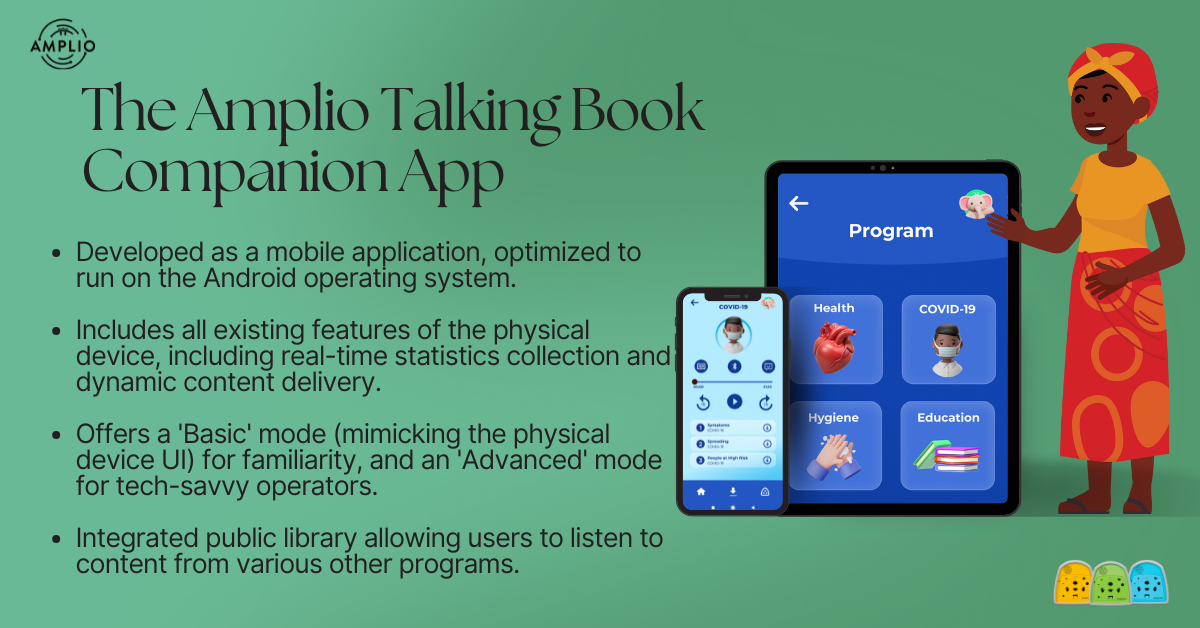
The impact of Amplio's Talking Books have reached over 2 million individuals across diverse sectors: livelihood, agriculture, health, women empowerment, peace and security, protection, and WASH (Water, Sanitation, and Hygiene). While this technology has served rural areas for 18 years, the expansion of mobile networks across sub-Saharan Africa has allowed for the development of an Android-based smartphone application. Known as the Talking Book mobile/companion app, it features a user interface designed in partnership with the School of Visual Concepts to navigate the specific challenges of digital inclusion for underserved populations.
“When we set out to develop the Amplio Talking Book companion app, we knew that the user interface (UI) would be critical to its success. A core priority in the development of this app was to create a UI that is truly accessible to users with low literacy, limited technology skills, and those living in areas with limited connectivity.” - Larry Asher, Director of SVC.
According to the Global System for Mobile Communications Association (GSMA) Intelligence, at the end of 2022, 4.3 billion people owned a smartphone. Of the 4.6 billion people using mobile internet, almost 4 billion do so using a smartphone (49% of the global population) and around 600 million people do so using a feature phone (8% of the global population). There are also 350 million people who own a smartphone but do not use mobile internet due to a variety of barriers - affordability, infrastructure, literacy, gender inequalities, and digital skills. This digital divide disproportionately affects women, who are 19% less likely than men to use mobile internet. Amplio's Talking Books have been instrumental in overcoming internet, literacy and language barriers, and the companion app aims to extend that impact on mobile platforms.
The School of Visual Concepts (SVC)
The School of Visual Concepts (SVC) is an institution known for its expertise in design education. SVC adopted a user-centered approach to the app's design. This approach prioritized simplicity, accessibility, and the effective use of audio and visual cues. Designing for this specific context required a deep understanding of the target users' needs and limitations.
Key Design Considerations and Solutions
The design process focused on several key considerations, resulting in specific design solutions:
- The design solution offers two modes: One that mimics the icons and operation of the previous Talking Book physical device and one that uses the conventions and iconography of modern phone-based audio apps.
- Recognizing the limited network connectivity in many target areas, SVC prioritized enabling offline access to content.
- The app includes user-friendly tools for recording and submitting audio feedback, facilitating the collection of valuable user insights.
.jpg)
Figure 1: A snapshot from the Android app.
In Conversation: Building the ATB Companion App
1. What were the most important principles that guided SVC's user-centered design approach for the ATB companion app, and why were they crucial for this project?
Larry: Every project we undertake starts with an understanding of the person who’s going to be using what we design. We always seek to know why they will use this product, what they think about other options to using the product, how familiar they are with the technology, and what situations they’ll be in when using the product. This is standard process in UX design and it’s a crucial one for making sure that designs solve problems for users, rather than just reflect untested assumptions about the user and their desires.
Ariana: The goal of our team was to step into the minds of Amplio's communities—to understand how they think, what they know from their environment, what resources they have access to and are familiar with, and how they associate meaning with certain terms. Designing an app for individuals with limited literacy skills was completely new territory for us, and it was something we knew had to be approached with care, empathy, and intention. This app wasn’t just a tool; it needed to represent a meaningful connection to both education and people. Education is a human right, one that should and can be translated across borders and cultures. While it would have been far more beneficial to physically immerse ourselves in their environments for deeper research, we worked with the options we had. That meant staying as present and inquisitive as possible in our virtual collaboration with the Amplio team—so we could understand their pain points, hopes, and overall experiences on a human level.
Keli: Our approach for this project focused on usability, accessibility, and efficiency. We wanted to keep the app as simple as possible in order to cater to users unfamiliar with modern technology, while still meeting Amplio’s business goals. Each screen is streamlined to show only the necessary functions, to enable the user to easily navigate throughout the app. In terms of accessibility, it was important that the app could be used by users that were completely illiterate. Last of all, we thought deeply about the user flow and what actions would be most efficient for the user to take during onboarding and afterwards. We needed to provide users with the technological assistance they might need while making it as easy as possible to access content.
.jpg)
2. What were the biggest design challenges you faced in creating an accessible UI for the companion app, and how did SVC overcome them?
Larry: The biggest challenge by far was designing for a user who has led a life quite different from the design team. It’s safe to say that everyone of the designers has used a smartphone for many years, is able to read English fluently, and is experienced in using apps and the internet – especially an internet that is available with few interruptions. Because we were unable to test our prototypes with the ultimate end-users because of time-zone, language, and other communication barriers, we had to simulate product testing with American children who have less digital and written language fluency. It wasn’t a perfect solution, but did give us some insight into solving this most significant challenge.
Chris: We were tasked with creating a mobile app to replace the physical Talking Book device, while supporting two very different user experiences.
The first experience needed to closely mirror the original Talking Book, a device designed for users with very low literacy and minimal exposure to mobile technology. Our challenge was to create an interface that fit within these constraints, offering a familiar and simple experience. While the digital platform gave us access to new tools like images and icons to support comprehension, our primary goal was to design an experience that left very little room for user error. Every interaction had to be intuitive, forgiving, and culturally appropriate.
The second experience was a more modern, app-like interface inspired by platforms like Spotify or Audible. This version was designed for users with higher literacy and digital fluency. The challenges here were more in line with standard UX design practices, ensuring the app included all necessary features, supporting common user goals, and presenting everything in a way that was easy to understand and navigate.
Ariana: With each phase of designing the app, new questions naturally came up along the way. Would they understand this image the same way we do? How can we teach modern iconography to someone who might be experiencing a mobile phone for the very first time? What are all the possibilities that could shape or influence their experience? These questions reminded us that we had to think two, even three steps ahead. We wanted to fulfill every corner, scratch every itch. The biggest challenge was sitting with the ongoing doubt: Is this app truly meeting every need, addressing every detail, and thoughtfully reaching each individual—considering who they are, what they know, and how they engage with the world?
Keli: Easily the biggest challenge we faced was creating an app for users of all literacy levels. A lot of the things our team takes for granted such as the ability to read, or navigate a website effortlessly, do not come naturally to the communities we are designing for. Essentially, we had to throw the conventional methods out the window and dig deep to ensure the app would function in an environment that we have no experience in. We had to find a way to indicate meaning and function without text. We did this by creating an entirely audio based app. Then, to help out users with limited experience with technology, we created tutorials and a friendly virtual assistant in order to limit frustration and pain points (while injecting a bit of playfulness into learning). There were endless questions along the way, and our team discussed every detail at length with the user’s best interests at heart. We left no stone unturned.
3. What is the most significant impact you hope the design of the companion app will have on its users, and what does this project mean to SVC?
Larry: It’s exciting to think that the work of our design teams may have an immediate effect on the health, productivity, and well-being of the people who will be using the Talking Book app. The vast majority of assignments we’re asked to help with are driven by a profit motive and are designed to boost ecommerce activity. It was a welcome change of pace to work on the Talking Book project where our efforts would be almost completely for the benefit of the user, not the organization sponsoring the work.
Ariana: The greatest impact could be that every individual using the companion app gains the knowledge they need to live a fruitful, safe, and confident life—not just for themselves, but for the generations before and after them. If we live in a world where so many have access to these opportunities, why shouldn't we extend that access to those who need it most? More than anything, I want them to feel hope—for their futures, whether it begins in the next moment or years from now.
Keli: I wholeheartedly believe in Amplio’s mission and hope that this app can expand their reach, increasing the impact they have on vulnerable communities. I can’t imagine working on anything more meaningful, and it was truly an honor to contribute to this project. My hope is simply that individuals in these communities are able to use knowledge gained through the app to improve their lives; whether it’s regarding their health, maternity care, agricultural practices, or any other area of their life– knowledge is power.
Gratitude and Future Vision
Effective UI design is crucial for driving app adoption, user engagement, and data collection. By prioritizing accessibility, Amplio and SVC are working to empower communities and ensure that vital information reaches the people who need it most.
The value of SVC’s contribution is highlighted by the Executive Director for Amplio Ghana, Gumah Tiah Aloysius who stated, “The outcome of SVC’s work has been absolutely instrumental in paving the way for the development of the companion app, and its launch will dramatically scale our impact. SVC’s exceptional work is a pivotal contribution to shaping our organization's strategic direction.”
Amplio expresses sincere gratitude to Larry Asher, Taylor Loran, Andressa Dalecio, Keli Hurst, Ariana Zahedi, Daniel Harrington, Raymond Au, and Chris Lafferty from the School of Visual Concepts and to Michael Dakura, Titus Ayamga and Lawrence Ephrim from the Amplio team for their invaluable contribution to the Talking Book companion app, and most importantly, to Arm for making this even possible. This collaboration exemplifies the power of design to create meaningful impact and bridge the digital divide.